Flyer vs Flier — Which Spelling Is Correct?
Is it flyer or flier? Both are real words, but only one is standard for print marketing. Here's which to use, why, and when each spelling is correct.
If you’ve typed both spellings while designing marketing materials or placing a print order, you’ve encountered one of the more low-stakes but persistent questions in the English language: is it “flyer” or “flier”?
Both are legitimate English words. Neither is a misspelling. But there are good reasons why one has become dominant in marketing and print contexts, and understanding the difference makes it easier to decide which to use consistently.
The Short Answer
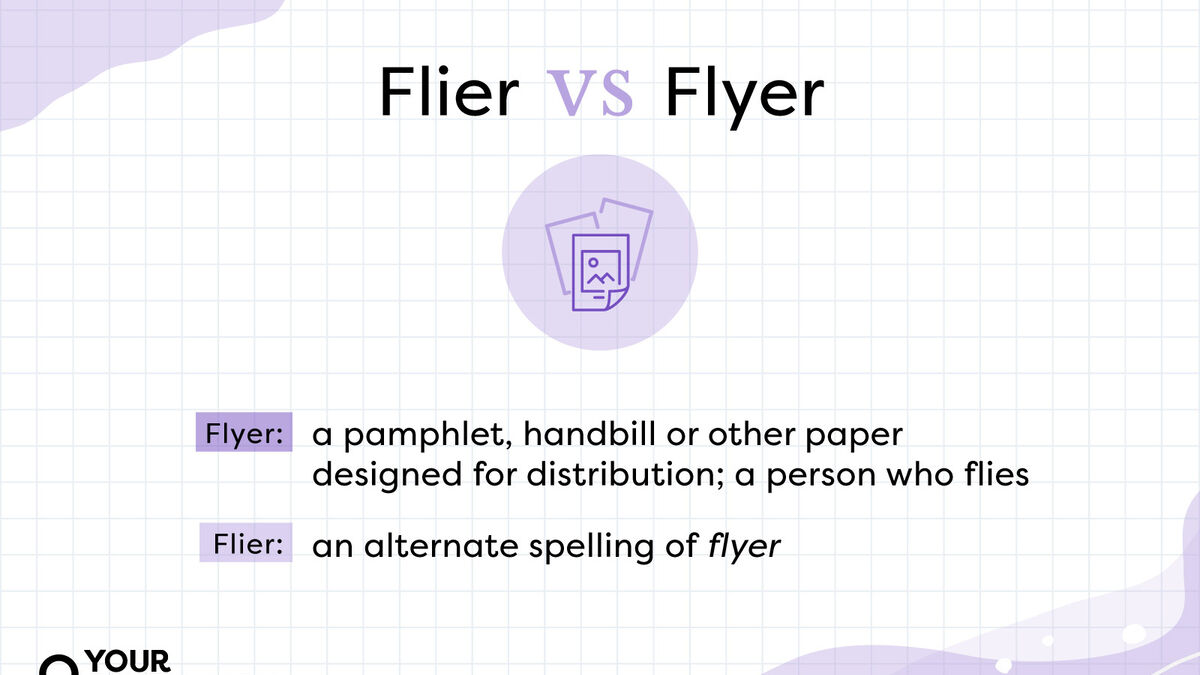
For a printed promotional document, flyer is the standard spelling. It’s used by the AP Stylebook for advertising circulars, appears in every major dictionary, and is the form used by virtually every professional printer, marketing platform, and design tool.
If you’re writing copy for a marketing campaign, ordering print materials, or naming your design files, use “flyer.”
The Origin of Both Spellings
Both “flyer” and “flier” come from the verb “to fly” with the common English suffix that creates agent nouns — something or someone that performs an action. The same suffix creates: worker, driver, teacher, runner.
In older English, “-ier” endings were common (crier, liar, friar). Over time, most agent nouns shifted toward “-er” endings. “Flier” preserves the older form; “flyer” is the modern normalized spelling.
Both appear in English dictionaries going back centuries. Neither emerged as a misspelling of the other — they’re simply two valid paths the language took for the same underlying construction.
Why “Flyer” Won for Print Marketing
Several factors drove “flyer” to dominance in marketing contexts:
Consistency with other print terms. Poster, banner, mailer, sticker — the marketing and print industry settled on “-er” endings throughout. “Flyer” fits that pattern; “flier” is an outlier.
Style guide guidance. The AP Stylebook — the standard reference for journalism and marketing writing — explicitly recommends “flyer” for an advertising circular, reserving “flier” for a person who flies. This guidance gave professional writers a clear rule, and practice followed.
Digital convention. When search engines, online print services, and design tools emerged, they standardized on “flyer.” Search for print material help and you’ll find “flyer printing,” “flyer templates,” “flyer design” — consistently with the “y.” This reinforced the spelling through sheer frequency.
The result: “flyer” for print materials is now so dominant that using “flier” in a marketing context, while technically correct, reads as unusual.
Where “Flier” Still Lives
Aviation contexts: “She’s an experienced flier” (a person who flies). “His flier’s license.” Aviation tends to preserve older English usage.
Frequent flier miles: This is a fixed phrase that dates from the early airline loyalty programs of the 1980s. Major airlines like American and Delta use “frequent flier” in their program names, and the phrase is now a set expression.
Some older style guides and publications: Organizations with pre-AP style guides may still use “flier” for all meanings. The New York Times, for example, historically used “flier” for print materials in some periods.
Informal notes and community postings: “Lost dog flier,” “apartment flier” — both spellings appear in informal contexts where no single style guide dominates.
AP Stylebook’s Explicit Guidance
The AP Stylebook, the reference standard for US journalism and much professional writing, distinguishes the two clearly:
- Flier: A person who flies. Also used in “frequent flier.”
- Flyer: An advertising circular.
This is the most precise and influential style guidance available. For anyone writing in a journalistic or professional marketing context, the AP distinction is the clearest rule to follow.
Which Should You Use?
Use flyer when:
- Referring to a printed promotional document, leaflet, or handout
- Writing marketing copy, product descriptions, or website content
- Ordering print materials from an online printer
- Naming design files and project folders
- Writing for general audiences in the US
Use flier when:
- Writing about someone who flies: “She’s a commercial flier”
- Using the fixed phrase “frequent flier miles”
- Following the house style of a publication that specifies “flier” for print materials
- Writing in contexts where “flier” is established convention (some aviation, historical)
The most important thing is consistency. If your business materials, website, and social posts all use “flyer,” picking one and maintaining it is better than mixing “flyer” in one place and “flier” in another.
Regional and International Considerations
The flyer/flier split is not primarily a regional (US vs UK) distinction, though some tendencies exist:
United States: “Flyer” is dominant for print materials across all regions.
United Kingdom: “Leaflet” is more commonly used than either “flyer” or “flier” for promotional print materials. When either spelling appears, “flyer” is more common.
Australia and Canada: Follow similar patterns to the US, with “flyer” as the more common form for print marketing.
For international content, “flyer” is the safer choice — it’s the most widely recognized spelling across English-speaking markets.
Other Names for the Same Thing
Print marketing language varies by context and country. The document commonly called a “flyer” in the US goes by several other names:
Leaflet: Standard UK term for a small promotional document. More formal than “flyer” in US usage.
Handbill: An older, more formal term for a printed notice distributed by hand. Used historically, still appears in some formal contexts.
Circular: A printed notice sent to multiple recipients. Common in direct mail contexts (“advertising circular,” “supermarket circular”).
Promotional insert: Specific to inserts in newspapers, packaging, or other materials.
Broadsheet: A large-format single-sheet print piece; historically a newspaper format, now also used for oversized promotional documents.
One-pager: Informal business term for a single-page information or marketing document.
For standard A5 or letter-size promotional documents distributed by hand or mailed, “flyer” remains the most universally understood term.
The Bottom Line
For print marketing, use “flyer.” It’s the standard form across the industry, the AP Stylebook’s recommendation for advertising circulars, and the dominant spelling in professional practice.
“Flier” isn’t wrong — it’s a correct English word with a long history. But in the context of print marketing, it reads as a variant that makes readers do a small double-take. “Flyer” is the form that blends in and communicates immediately.
Pick one, use it consistently, and move on to the more interesting design and printing decisions. For everything after the spelling, see our flyer design guide and cheapest flyer printing comparison.
Frequently Asked Questions
Is it flyer or flier?
Both are correct English words. “Flyer” is standard for print marketing materials. “Flier” is used for a person who flies and in “frequent flier miles.”
What’s the difference between flyer and flier?
“Flyer” = printed promotional document. “Flier” = a person who flies, or the fixed phrase “frequent flier.” Either can technically refer to print materials, but “flyer” is now the dominant form.
What do you call a printed advertising leaflet?
A flyer (also called a leaflet in UK English, or handbill, circular, or promotional insert).
Does the AP Stylebook use flyer or flier?
AP recommends “flier” for a person who flies and “flyer” for an advertising circular.
Is flyer one word or two words?
One word — “flyer.” Plural: “flyers.”
What is the plural of flyer?
Flyers. “We distributed 1,000 flyers.”
When should I use “flier” instead of “flyer”?
For aviation contexts (“a flier’s license”) and the fixed phrase “frequent flier miles.” For print marketing, use “flyer.”
Is flyer American English or British English?
“Flyer” is used in both, though British English often uses “leaflet” instead. “Flier” is not primarily a British spelling — it’s just the older form of the same word.